

Date: May 23, 2024
Interviewee: Omar Constant
Interviewer: Dr. Asfia Kamal
Location: Opaskwayak Cree Nation
Recording Method: Audio/Video
Transcript Style: Verbatim Transcription
Editorial Note
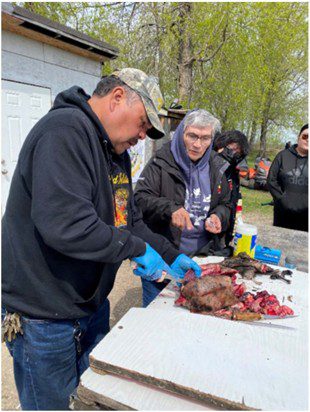
This conversational interview is featured in Muses from the North’s special issue on Land-Based Teaching and Leaming. It took place on May 23, 2024, at Diamond Willow Camp in the Opaskwayak Cree Nation during a land-based learning class offered through the University College of the North (UCN). The conversation was recorded in both audio and video formats and transcribed verbatim by Emily Bushby, the research assistant for this project.
Omar Constant is a knowledge keeper, hunter, fisher, and land-based educator from the Opaskwayak Cree Nation (OCN). He founded Diamond Willow Camp with his wife, creating a space for community members, youth, and university students to reconnect with the land through traditional practices. His teachings focus on food sovereignty, intergenerational knowledge transmission, and the responsibility of land stewardship.
The interview was conducted by Dr. Asfia Kamal as part of ongoing collaborative research between UCN and community-based educators in Treaty 5 territory. It is reproduced here with the knowledge and consent of Omar Constant and is intended to contribute to the growing body of scholarship that recognizes oral tradition, lived experience, and land-based ways of knowing as legitimate and vital forms of knowledge.
Introduction
This interview was conducted as an informal conversation with Omar Constant, a respected knowledge keeper from Opaskwayak Cree Nation. Omar has spent his life living closely with the land and practicing traditional land-based ways of life, including hunting, fishing, trapping, and sharing cultural knowledge with younger generations. Together with his wife, Crystal Constant, he has established Diamond Willow Camp, a land-based learning space where knowledge is shared with community members, youth, and students from schools and universities.
At Diamond Willow Camp, Omar and his wife welcome learners who wish to reconnect with the land and learn traditional skills such as hunting, fishing, water stewardship, and food sharing practices. Their work reflects a deep commitment to Indigenous food sovereignty, cultural continuity, and land stewardship. Both Omar and his wife are experienced hunters and fishers who deeply value land-based ways of life and the teachings that come from living on the land.
The conversation took place during a land-based learning class in Opaskwayak Cree Nation. The discussion focused on the importance of land-based education, the role of traditional knowledge in contemporary society, and how these teachings can be incorporated into educational settings, including university programs.
Transcript
Omar: Hi, my name is Omar Constant. I’ve been a member of Opaskwayak Cree Nation all my life, and I have lived here since 1974, living off the land and using the land to its full potential.
Dr. Kamal: Why is land-based learning so important?
Omar: In this day and age, when I was growing up, I had access to my uncles and their friends, and they always used the land. They went duck hunting, moose hunting, and trapping. During that upbringing, I had an uncle who always did trapping, so I focused with him in the springtime. I had another uncle who did waterfowl hunting, so I stayed with him during that season. Then I had another uncle who went moose hunting, so I had access to those three uncles and their resources and knowledge.
Now that they have passed away, we are kind of picking up their traditions, and it has become part of our passion as well.
In this day and age, you do not see that as much anymore. It is kind of like a lost generation. Right now, I have my son’s generation, so I am teaching him what I know. But many of his friends do not know how to go duck hunting, waterfowl hunting, or moose hunting. And if they do get game, they do not always know what to do with it.
So a part of land-based learning is passing on the traditional knowledge that was given to us by our previous generations.
Now, when I get to the point where my uncles were in their lives, I am hoping my son will carry on the traditions that we are keeping alive. It is so important to have those values in place because it helps ease the mind, but it is also physical work, so it keeps your body active. When you are out there on the land, you are kind of at peace.
If you have a stressful job and go out on the land, those elements help you regroup. At the same time, you are giving thanks to the Creator for giving you your vision, your hearing, and your physical well-being to get out there. The land can help guide you through your problems.
There was a time in my life when I was troubled. I went out onto the land by the river and asked questions about life. The ice was moving, and I asked myself, “Why is life so hard?”
Then I saw a little muskrat moving between the icebergs. I thought it might get crushed. But what I realized was that the muskrat was making its way from one point to another despite the obstacles. That showed me that you can get from point A to point B no matter what obstacles you face, as long as you keep moving forward.
That was a teaching I received from the land, and it is one of the reasons why land-based knowledge is so important.
At another moment, I asked, “Why am I here? What is my purpose?” Just then, a mallard duck flew right beside me. That moment showed me that my role was to be a provider for my family and community.
You may not get answers right away when you ask questions on the land, but sometimes the answers come later.
Another reason land-based learning is important today is because of technology. Going out onto the land gives you a break from all of that. It becomes just you and nature.
My wife once explained the concept of food sovereignty to me. We have always gone onto the land to gather our water and food. When we harvest, we share it with the elders first, then with families who are unable to hunt or harvest themselves.
Those who are able to access the land are encouraged to join us and learn. That is how knowledge is shared.
Food sovereignty also means stewardship of the land. We look after our waters and the land. If we see something wrong, we report it. If we see something unusual or if we encounter a sick animal, we report it. It is our responsibility to take care of the land.
Dr. Kamal: What do you think should be included in land-based teaching within the university curriculum?
Omar: Having land-based learning in the school system is important. In my workplace we have brought youth onto the land many times. What we have seen is that it gives students opportunities to experience places beyond the streets of their communities. We show them landmarks, waterways, and the broader landscape.
Those experiences stay with them. Years later, students come back and say, “Remember when we went moose hunting? I practiced that call you taught us.”
They take those teachings and make them their own. That is the key. When someone takes what you have taught them and uses it in their own life and eventually passes it on, that is the real importance of land-based education.
Not all students have the opportunity to learn these skills at home, so providing those experiences through schools and universities is very important.
Concluding Remarks by Asfia Kamal
The conversation concluded as Omar needed to begin a medicine teaching session for the land-based class for UCN that had gathered at the camp. Although the discussion was brief and informal, Omar’s insights offered powerful reflections on the importance of land-based knowledge, intergenerational learning, and stewardship of the land.
Omar’s experiences illustrate the value of integrating land-based learning into educational settings, where students can reconnect with the land, learn traditional knowledge, and understand the responsibilities that come with caring for the environment. His reflections continue to inspire educators and students alike to see the land not only as a place of sustenance but also as a teacher.