Editorial Note
The essay “From Felt Theory to Strength-Based Resurgence” serves as the scholarly foundation for this special issue. It provides readers with a theoretical framework for understanding the student contributions that follow, viewing them not just as personal stories but also as political and epistemological acts. Drawing on Dian Million’s concept of felt theory and expanding it into what the author calls strength-based felt theory, the essay argues that the joy, belonging, pride, and humility expressed by students in UCN’s land-based courses are not merely incidental emotions; rather, they represent forms of political knowledge. This knowledge reflects Indigenous resurgence as it occurs in real time within a northern Manitoba classroom.
What makes this essay particularly significant as an introduction to the collection is its assertion that land-based education at UCN is not just an enrichment program. It constitutes epistemic restructuring, survival literacy, and governance training, all within a region shaped by hydroelectric colonialism, wildfire disruption, and food insecurity. The learning processes and outcomes of the land pedagogy courses are illustrated through both academic and creative student pieces, as well as the guidance provided by Elders and knowledge keepers, as reflected in the instructor’s interviews.
The student contributions that follow-narratives of fishing trips and family harvests, poems about berries, grandfathers, and macaroni salad, and recipes passed down by grandmothers-are not merely illustrative anecdotes supporting the essay’s argument. Instead, they embody the argument itself, presented in the form it has always taken on this land: relational, experiential, and passed down through generations.
The subsequent essay by the guest editor of this special issue provides the theoretical framework informing the collection. It draws from students’ focus group discussions and conversational interviews conducted within UCN’s Land Pedagogy I and Food Sustainability and Indigenous Knowledge courses, which were approved by the UCN Research Ethics Board in April 2025.
Introduction
In Indigenous feminist scholarship, Dian Million’s (2009) articulation of felt theory fundamentally shifted how scholars understand the relationship between emotion and political knowledge. Million argues that feeling-particularly grief, trauma, and embodied memory-is not separate from politics but constitutes a form of theory itself Indigenous women’s testimonies of residential schools, colonial violence, and intergenerational suffering are not confessional narratives but epistemological interventions into settler colonial structures (Million, 2009, pp. 54-56). In this framing, the body becomes an archive and affect becomes analytic. Felt theory insists that emotion is not weakness; it is knowledge.
Yet within the northern land-based classrooms of the University College of the North (UCN), another affective register consistently emerges-one centred not primarily on trauma but on belonging, pride, relational grounding, humility, laughter, gratitude, and intergenerational reconnection. Students participating in Land Pedagogy I and Food Sustainability and Indigenous Knowledge described their learning not only as intellectually meaningful but also as emotionally transformative. They spoke of feeling “at home,” of rediscovering relationships with ancestors, of finding purpose through harvesting, of pride in feeding others, and of humility before bees and medicines. These emotions were not incidental; they marked shifts in identity, responsibility, and worldview.
This paper advances the thesis that positive affect-joy, pride, belonging, relational responsibility-constitutes political knowledge and should be theorized as a strength-based extension of felt theory. While trauma-centred affect reveals colonial harm, strength-based affect reveals Indigenous continuity, resurgence, and governance capacity. Drawing from focus group discussions and conversational interviews conducted within UCN’s land-based courses (approved by the UCN Research Ethics Board in April 2025), this research argues that land-based pedagogy in northern Manitoba generates affective transformations that function as epistemologies of sovereignty. Joy itself becomes governance literacy. Belonging becomes territorial reorientation. Pride becomes enactment of self-determination.
In a northern university context shaped by hydroelectric development, wildfire disruption, food insecurity, and regulatory colonialism, land-based learning is not supplementary enrichment-it is epistemic restructuring. The emotional transformations articulated by students reveal not sentimentality but resurgence in practice.
Project Background and Northern Context
The University College of the North operates within northern Manitoba, serving predominantly Indigenous communities across Treaty 5 territory and surrounding boreal forest regions. With campuses in Thompson and The Pas, UCN is geographically and politically situated in a landscape shaped by hydroelectric infrastructure, fluctuating food prices, wildfire displacement, mining economies, and long-standing Indigenous land relationships. Unlike southern universities detached from rural realities, UCN exists in intimate proximity to the communities it serves.
The land-based courses analyzed in this research-Land Pedagogy I (summer) and Food Sustainability and Indigenous Knowledge (fall)-form part of an ongoing community-driven initiative rooted in relational teaching, Elder guidance, and northern food sovereignty. During the 2025 cycle, wildfire conditions across northern Manitoba required adaptive integration of summer activities into the fall term. Rather than cancelling programming, instructors and community partners reorganized learning around five interconnected themes: beekeeping and northern ecosystems in collaboration with Arctic Gold Honey; boreal forest food growing through Boreal Discovery Centre; land-based medicine teachings guided by Elder Carol Sanoffsky; canning and story sharing led by Chief Shirley Ducharme and Elder Steve Ducharme; and communal soup and bannock baking.
Although wildfire conditions prevented certain community trips, relational continuity persisted. Elders continued to provide teachings. Community members offered guidance remotely. The Northern Manitoba Food Culture and Community Collaborative (NMFCCC) and CEWIL Canada provided financial and institutional support, while Inter-University Services strengthened student participation. O-Pipon-Na-Piwin Cree Nation contributed to lesson planning and reflection despite wildfire limitations.
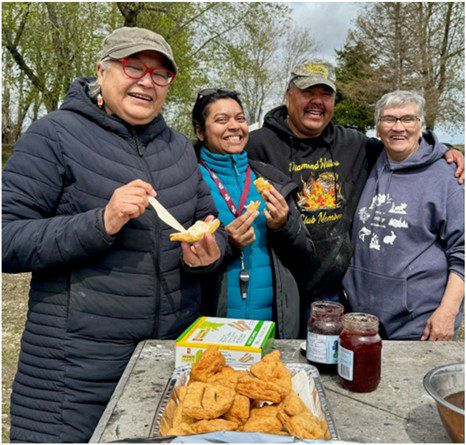
A particularly significant outcome of sustained land-based programming was voluntary student engagement beyond course requirements. Students from previous Land Pedagogy cohorts returned to assist with fall activities. Volunteer participants from other faculties joined sessions without academic credit. Students brought children, siblings, and parents into harvesting spaces, transforming university grounds into intergenerational learning sites. These practices demonstrate that land-based education at UCN extends beyond classroom boundaries; it cultivates responsibility, continuity, and relational accountability.
Northern Manitoba is not the backdrop in this research. It is an active context. The boreal forest, wild rice lakes, berry patches, hydro reservoirs, and wildfire-affected lands shape the emotional and political landscape in which students learn. Regulatory frameworks such as the Safe Food for Canadians Act restrict the public serving of wild meat, producing tensions between traditional food sharing and state oversight. High grocery costs and remote community access intensify the importance of food sovereignty. In this environment, harvesting potatoes, tending bees, preparing bannock, and canning fish are not nostalgic acts; they are materially and politically consequential.
Methodology
This research is grounded in an Indigenous research paradigm emphasizing relational accountability, reciprocity, respect, and responsibility (Wilson, 2008). Knowledge is not extracted; it is shared. The research emerged from two formal focus group discussions conducted near the conclusion of the land-based courses and from conversational interviews during hands-on activities such as harvesting, beekeeping, medicine gathering, and food preparation.
Ethics approval was granted by the UCN Research Ethics Board in April 2025. Participants provided informed consent, and confidentiality protocols were maintained. Beyond institutional ethics compliance, the research adhered to OCAP principles-Ownership, Control, Access, and Possession-ensuring that knowledge shared by students remained relationally accountable.
As an instructor-researcher, I participated alongside students in every activity. I harvested, cooked, organized Elder sessions, and navigated disruptions caused by wildfires. My positionality is not that of a detached observer but rather that of a relational participant. Many students returned from previous courses; I am personally connected to their educational journeys. Within Indigenous research paradigms, such relational proximity strengthens rather than compromises rigour (Wilson, 2008). Trust cultivated through shared labour enabled deeper reflection during focus groups.
Data analysis involved iterative reading of transcripts and field notes, identifying recurring affective themes such as belonging, pride, humility, gratitude, frustration with regulation, healing, and intergenerational connection. Rather than coding for deficit indicators alone, the analysis centred on strength-based affect and its political implications.
Reframing Felt Theory: From Trauma to Strength
Million’s (2009) felt theory foregrounded trauma as political knowledge, arguing that grief and embodied suffering reveal colonial violence (p. 54). This intervention remains foundational.
However, felt experience extends beyond pain. Affect shapes subjectivity broadly (Million, 2013, p. 32). If trauma can mobilize critique, joy can mobilize resurgence.
Students in UCN’s land-based courses rarely framed their reflections solely through harm.
Instead, they articulated empowerment, belonging, pride, and relational clarity. One participant stated, “This class made me feel like I belong.” Another described harvesting potatoes as “like gathering a community.” A student reflected that beekeeping shifted fear into humility and respect. These emotional expressions are not apolitical; they reveal shifts in relational governance.
Strength-based felt theory, therefore, extends Million’s framework by arguing that empowering affect is political knowledge. Belonging indicates territorial grounding. Pride signals capacity. Humility before land signals ethical recalibration. Laughter during communal harvesting demonstrates relational governance in practice.
This theoretical shift does not dismiss trauma-centred analysis; it complements it. Trauma-centred felt theory answers: What has colonialism done? Strength-based felt theory asks: What continues despite colonialism? What regenerates? What grows?
Data Reflections: Belonging, Pride, and Relational Governance
Students repeatedly articulated belonging as transformative. One noted, “This class made me feel like I belong.” Another shared that land-based activities felt “like home.” These statements suggest institutional reterritorialization. University space, often experienced as alienating within Western academic structures, becomes Indigenous space through relational land practice.
Table I presents selected excerpts and analytic interpretations.
Student Expression
“This class made me feel like I belong.”
“It feels like home.”
“Like gathering a community.”
Affective Register
Belonging
Comfort
Collective Joy
Political Interpretation
Reclaims institutional space as Indigenous territory.
Counters the alienation in Western academic systems.
Enacts Relational governance through shared labour.
Students also described pride in food preparation. One participant reflected that learning to can and share food restored a connection to grandparents. Another stated that feeding others through harvested food felt empowering. These narratives reveal pride not as individual achievement but as relational responsibility.
Practice
Harvesting poatoes together
Beekeeping
Sharing wild meat
Emotional Response
Pride
Humility and respect
Gratitude
Governance Meaning
Collective food sovereignty enacted.
Ethical engagement with the ecosystem.
Redistribution model beyond capitalist logic.
Students’ frustration with regulatory restrictions on the sharing of wild meat revealed their political literacy. Anger at inequitable policies did not lead to resignation but rather strengthened commitment to community-based food systems (Safe Food for Canadians Act, 2012). Here, negative affect-frustration-also functions within strength-based felt theory as critical awareness tied to relational accountability.
Why Land-Based Learning Matters at UCN
UCN occupies a unique position in Canada’s postsecondary landscape. As a northern institution embedded within Indigenous communities, it has responsibility not only to deliver curriculum but to cultivate relational continuity. Students navigating between remote communities and institutional spaces often experience fragmentation. Land-based pedagogy stabilizes identity by grounding learning in place.
Students expressed surprise that such courses exist within university settings, suggesting that land-based knowledge remains marginalized elsewhere. In northern contexts marked by hydro displacement, wildfire, and food insecurity, teaching land-based food systems is not enrichment; it is survival literacy and governance training.
Including land-based pedagogy within university programming strengthens retention, fosters intergenerational engagement, and re-centers Indigenous epistemologies. When students bring children into harvesting spaces, they collapse the boundary between institution and community. The classroom becomes a site of collective care.
Strength-based felt theory reveals that institutional success should not be measured solely by grades or credit accumulation, but by relational transformation. When students articulate a sense of belonging and pride, they signal that the institution is fulfilling its northern mandate.
Conclusion
Dian Million’s felt theory reoriented Indigenous scholarship toward recognizing emotion as political knowledge. This paper extends that insight by articulating a strength-based felt theory, in which joy, belonging, pride, humility, and relational responsibility function as epistemologies of resurgence.
Within UCN’s land-based classrooms in northern Manitoba, students’ emotional transformations demonstrate that sovereignty is felt before it is legislated. Harvesting becomes a governance practice. Laughter becomes relational pedagogy. Pride in feeding others becomes an assertion of food sovereignty. Belonging becomes territorial reorientation within institutional space.
In regions shaped by regulatory colonialism, hydro development, and wildfire disruption, land-based pedagogy cultivates governance literacy through affective transformation. Strength-based felt theory does not replace trauma-centred analysis; it complements it. Where trauma reveals harm, joy reveals continuity.
Land-based education at UCN, therefore, stands not as supplementary programming but as an epistemic foundation. In these classrooms, resurgence is not an abstract concept-it is felt, practiced, and shared.
References
Ahmed, S. (2004). The cultural politics of emotion. Edinburgh University Press. Canada. (2012). Safe Food for Canadians Act, S.C. 2012, c. 24. Government of Canada. First Nations Information Governance Centre. (2014). Ownership, Control, Access and
Possession (OCAP®): The path to First Nations information governance.
Kovach, M. (2009). Indigenous methodologies: Characteristics, conversations, and contexts.
University of Toronto Press.
Million, D. (2009). Felt theory: An Indigenous feminist approach to affect and history. Wicazo Sa Review, 24(2), 53-76.
Million, D. (2013). Therapeutic nations: Healing in an age of Indigenous human rights.
University of Arizona Press.
Simpson, L.B. (2014). Land as pedagogy: Nishnaabeg intelligence and rebellious transformation. Decolonization: Indigeneity, Education & Society, 3(3), 1-25.
Smith, L. T. (2012). Decolonizing methodologies: Research and Indigenous peoples (2nd ed.).
Zed Books.
Tuck, E., McKenzie, M., & McCoy, K. (2014). Land education: Indigenous, post-colonial, and decolonizing perspectives on place and environmental education research. Environmental Education Research, 20(1), 1-23.
Wildcat, M., McDonald, M., Irlbacher-Fox, S., & Coulthard, G. (2014). Learning from the land: Indigenous land-based pedagogy and decolonization. Decolonization: Indigeneity, Education & Society, 3(3), 1-15.
Wilson, S. (2008). Research is ceremony: Indigenous research methods. Fernwood Publishing.