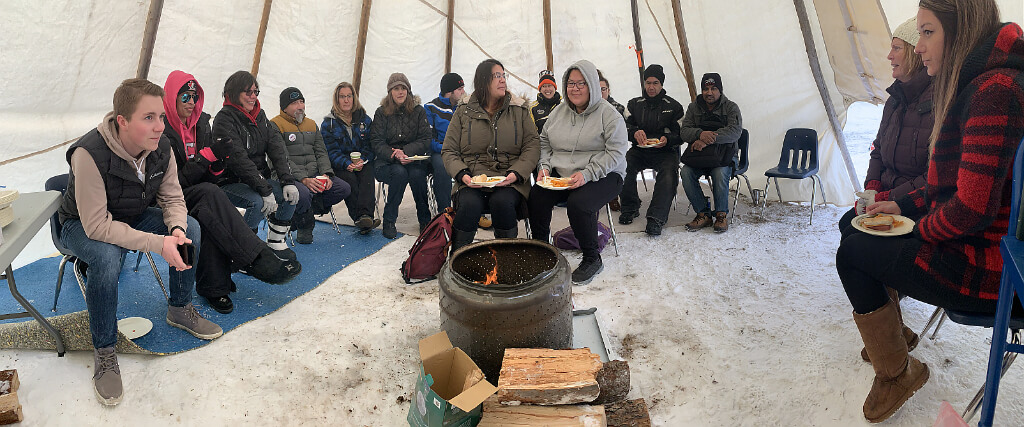
Program Overview
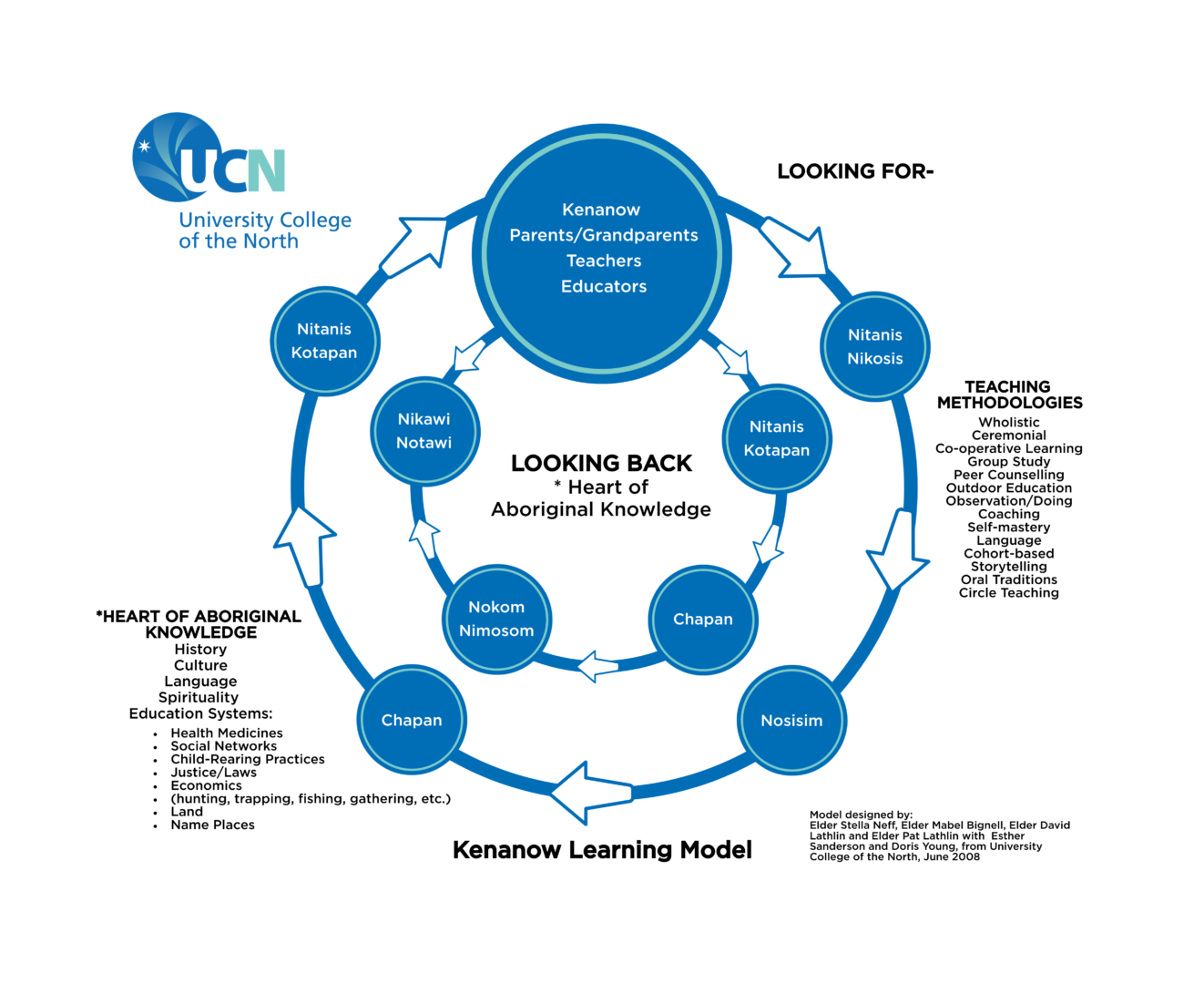
During the development of the program, extensive consultation occurred with a variety of regional stakeholders. The suggestions, opinions, and knowledge shared by the stakeholders are reflected in the program content. The Kenanow program philosophy reflects the mission statement of UCN. The Seven Sacred Teachings – wisdom, respect, truth, humility, honesty, bravery and love – are embedded in the design and delivery of the program. Please see the Kenanow Model.
The program has a Middle Years focus but prepares graduates to teach students at all grade levels. The program aims to graduate teachers who are aware of and responsive to the needs of their students. When implementing curricula, graduates of the program will have the skills to link provincial curricula in a culturally meaningful way to the life experiences of their students. Graduates of the program will not only be proficient enough as teachers to effectively meet the needs of children and youth in the north, but capable of teaching effectively with a land-based component anywhere in Manitoba. Graduates of the program are eligible to apply for professional certification through Manitoba Education.
– Apply Now
Certification Options
Students may fulfill the requirements for the breadth courses and the teachable subjects while enrolled in the integrated Bachelor of Arts/Bachelor of Education program. Students must fulfill the requirements for a Bachelor of Arts and the Bachelor of Education.
Students may fulfill the requirements for the breadth courses and the teachable subjects while enrolled in the integrated Bachelor of Interdisciplinary Studies/Bachelor of Education program. Students must fulfill the requirements for a Bachelor of Interdisciplinary Studies and the Bachelor of Education
- Students with an undergraduate degree may be registered in the After Degree Stream of the Bachelor of Education program.
- Students will complete 60 credit hours of education courses.
Why Study Kenanow Bachelor of Education at UCN?
The Kenanow Bachelor of Education program is unique in its approach to teacher education. Kenanow is a traditional Cree Indigenous learning model. The word Kenanow means “all of us” or “all of us who are here” and emphasizes the relationships between and among people. The Kenanow Learning Model was adopted by the Elders as the framework for the UCN teacher education program. As a learning model, Kenanow has served Indigenous people for generations. Kenanow connects identity, place, community history, roles and responsibilities, and the process of handing down knowledge. The Elders believe that the Kenanow model provides a foundation that encompasses the past, the present and the future in education for northern and Indigenous students. The model and the program seek to:
- Reclaim and rekindle the connectedness of students to the community.
- To enhance the students’ sense of identity as learners, family, and community members.

Career Outcomes and Community
The Kenanow Bachelor of Education Program is intended to address the need for Indigenous and northern teachers in Manitoba. Upon successful completion of the program students are eligible to apply for their Manitoba Teacher Certificate.
Students graduating from the Kenanow Bachelor of Education Program are eligible to teach anywhere in Manitoba and Canada.
Alumni, Student Spotlights & Related Stories



Program Schedule
| Course | Course Title | Credits |
|---|---|---|
| ABS.1001 | Waskawimakanwa Mecimwaci Isihtwawina | 1 |
| EDU.3000 | Introduction to Teaching | 3 |
| EDU.3010 | Educating Children and Youth | 3 |
| EDU.3015 | Teaching Practicum 1 | 3 |
| EDU.3016 | Teaching Practicum 2 | 3 |
| EDU.3020 | English Language Arts Methods | 3 |
| EDU.3030 | Mathematics Methods | 3 |
| EDU.3035 | Social Studies Methods | 3 |
| EDU.3040 | Science Methods | 3 |
| EDU.3045 | Aboriginal Perspective for Teachers | 3 |
| EDU.3050 | School Relationships | 3 |
| EDU.4010 | Assessment Practices | 3 |
| EDU.4015 | Teaching Practicum 3 | 3 |
| EDU.4016 | Teaching Practicum 4 | 3 |
| EDU.4020 | Teaching Students with Diverse Learning Needs | 3 |
| EDU.4021 | Reading Instruction and Literacy Acquisition | 3 |
| EDU.4025 | The Multilevel Learning Community | 3 |
| EDU.4030 | Learning Technologies | 3 |
| EDU.4035 | Principles of Learning and Development | 3 |
| EDU.4055 | Teaching Sport | 3 |
| Course | Course Title | Credits |
|---|---|---|
| EDU.4040 | Instruction of Aboriginal Languages | 3 |
| EDU.4045 | Teaching Sustainable Development | 3 |
| EDU.4050 | Teaching Internship | 3 |
| EDU.4051 | Sociology/Anthropology of Education Seminar | 3 |
| EDU.4061 | Teaching Practical Arts | 3 |
| EDU.4062 | Teaching Business Education | 3 |
Admissions
Requirements
- Grade 12 with a regular or mature high school diploma, with
- Language Arts (English) 40S, one credit
- Pre-Calculus Mathematics 40S, Applied Mathematics 40S or Essential mathematics 40S
- Or equivalencies of above
- Letter of Recommendation – A letter of recommendation from at least one certified, experienced teacher with be required
- Interview – The applicant must be interviewed by a selection committee and recommended by the committee for entrance to the Kenanow Bachelor of Education program
For more info on Mature Student and other Bachelor of Arts Admission Requirements (see page 30 of the 2025-2026 Academic Calendar) – Apply Now
Estimated Cost
Bachelor of Education – Thompson →
Bachelor of Education – The Pas →
Application Fee
- Domestic Student Application Fee: $52
- International Student Application Fee: $164
Important Dates and Deadlines
Program Start Date
September 8, 2026
Program End Date
April 16, 2027
Frequently Asked Questions (FAQ)
The Kenanaw Learning Model is an education system that served Aboriginal people well for generations throughout time and history. It is about identity, a place of belonging, community history, roles and responsibilities of generations of families and the process of handing down knowledge in a larger context, the community that supports and nourishes the heart, mind, body and spirit. For Ininiwak, the Cree, the education system was transmitted through the families and communities as represented in the Kenanaw Learning Model.
Kenanaw was chosen by the Council of Elders at the UCN as the concept for the framework of the UCN teacher education program. The choice was made because for years, the public school system failed to meet Aboriginal student educational needs in many areas. These areas included the preparation of prospective teacher candidates in the teacher education programs, the program curricula, the instructional practices, text materials, and methods of teaching Aboriginal students.
Through the Kenanaw Learning Model a new foundation of teacher education is created that looks to the past, present and future for the education of northern and Aboriginal students.
The Kenanow learning model bridges the link between western education perspectives and the Aboriginal perspectives in the transmission of knowledge. Kenanow is a word drawn from the Cree language. Translated literally, it usually reads “all of us’, all of us who are here” which includes all our relations as described in the model. In this model the kinship system is envisioned as an organically functioning system into which education is naturally and harmoniously integrated and transmitted.