
Program Overview
This program is designed to teach students the skills necessary to become a welding operator, welder’s helper, or apprentice.
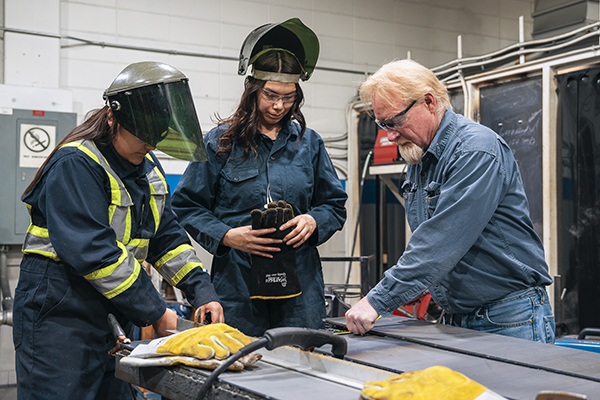
The program is heavily oriented toward hands-on experience. The practical portion includes training in arc welding, oxyacetylene welding, brazing, Gas Metal Arc Welding (GMAW), Gas Tungsten Arc Welding (GTAW), and arc-air cutting. Fundamentals of proper tool and equipment usage are also covered.
Each course within the program includes curriculum related to occupational safety and health. Both the theoretical and practical components emphasize the knowledge and practices required to maintain a safe workplace.
– Apply Now
Why Study Industrial Welding at UCN?
- Gain hands-on welding skills using industry-standard tools and techniques.
- Learn in-demand trades skills that lead directly to employment opportunities.
- Build a strong foundation for apprenticeship and long-term career advancement
Career Outcomes and Community
Graduates of this program receive a certificate and are prepared for employment in:
- Fabrication shops
- Maintenance departments
- Repair facilities.
Graduates may also pursue further training through an apprenticeship program to attain a journeyperson’s certificate. Acceptance into an apprenticeship program requires approval from both the employer and Apprenticeship Manitoba (Entrepreneurship, Training & Trade).
Apprenticeship
Any individual who successfully completes this program with a minimum passing grade of 70% in all courses and registers as an apprentice within two years of program completion will be eligible to receive Level 1 in-class academic training for the associated apprenticeship program. For information regarding the required hours for Level 1 practical training, please consult Apprenticeship Manitoba.
Program Schedule
| Course | Course Title | Credits |
|---|---|---|
| ABS.1001 | Waskawimakanwa Mecimwaci Isihtwawina | 1 |
| ART.1681 | Pre-employment Trades Communication | 2 |
| BTR.1912 | Core Occupational Health and Safety | 2 |
| EXT.0158 | Standard First Aid with CPR (St. John Ambulance) | 0 |
| ITA.0101 | Welding Theory 1 | 6 |
| ITA.0111 | Welding Practice 1 | 6 |
| ITA.0131 | Welding Theory 2 | 6 |
| ITA.0161 | Welding Practice 2 | 6 |
| ITA.0190 | Practicum | 1 |
| MSC.1410 | Mathematics 1 | 1 |
| MSC.1420 | Mathematics 2 | 1 |
| MSC.1430 | Science 1 | 1 |
| MSC.1440 | Science 2 | 1 |
| VTR.0201 | Print Reading | 3 |
| VTR.0240 | Drafting | 2 |
| VTR.1710 | Machine Shop | 2 |
Admissions
Requirements
a. English 20F, and
b. Pre-Calculus Mathematics 20S, Applied Mathematics 20S or
Essential Mathematics 20S, and
c. Science 20F or Science 20G,
d. Or equivalencies of above,
e. Or mature student, see 2.01 or the Academic Calendar.
Candidates should have good manual dexterity and eyesight and a mechanical aptitude. Those who are sensitive to bright lights or who have respiratory difficulties will be at a disadvantage in this field of study.
Estimated Cost
$ 6,906.90
See the program cost sheet for full breakdown of costs.
Application Fee
- Domestic Student Application Fee: $52
- International Student Application Fee: $164
Important Dates and Deadlines
Program Start Date
October 13, 2026
Program End Date
June 11, 2027