


Editorial Note
“From Land to Language” stands apart in this collection as the only piece that takes the reader beyond a single community or kitchen or lakeshore and into the larger landscape of Indigenous language revitalization and land-based education as a national movement. Written by a UCN graduate who attended both the WAVES 2025 Global Indigenous Languages Summit in Ottawa and a land-based course in Victoria with the Snuneymuxw First Nation, the essay situates the themes of this special issue within a broader context: these are not local concerns but urgent, living, international conversations about what it means to reclaim language, land, and identity after generations of colonial disruption.
What makes this piece particularly significant is its perspective. The author writes not only as a learner but as a future teacher – someone already thinking about how to carry these teachings forward into classrooms and communities. The reflection on Cree as a describing language, and on the land as the place where those descriptions come alive, is one of the most precise and original statements of land-language connection in this entire collection. And the author’s disclosure of their family’s experience with Residential Schools and the Sixties Scoop gives the piece its deepest resonance: this is not abstract advocacy but a personal act of reclamation, offered with honesty and hope.
The summer of 2025 was incredibly busy and rewarding. In June, I graduated with my three-year Bachelor of Arts degree from the University College of the North (UCN). Soon after, I worked at Into the Wild at UCN in July and part of August before attending the WAVES 2025 Global Indigenous Languages Summit in Ottawa. I received an invitation to this important summit from members of the Rideau Hall Foundation and Commissioner Ronald E. Ignace, from the Office of the Commissioner of Indigenous Languages. This invitation followed my participation on a student panel at the Manitoba Aboriginal Languages Strategy (MALS) Annual Language Symposium, proudly hosted by UCN’s Indigenous Initiatives and Reconciliation division. The RHF members explained that 25 teachers and student teachers from across Canada would be sponsored to attend the WAVES Summit.
Shortly after the WAVES Summit, I travelled to Victoria, British Columbia, to participate in the Land-Based Teaching and Learning for Sustainable Development course offered through the Kenanow Education Program at UCN.
When the opportunity to speak on the symposium panel first arose, I was hesitant. I had never spoken in public before and felt nervous. However, with encouragement-especially from Melanie Molin, one of my instructors at UCN-I decided to participate. Listening to presenters discuss Indigenous language revitalization was both inspiring and affirming. On the panel, I shared my experience learning the Cree language and heard Elders and knowledge keepers discuss the necessary actions to keep our languages alive. After the presentations, we engaged in land-based activities, and I signed up to learn about Indigenous land-based learning.
Looking back, I am grateful that I overcame my fears and spoke on the panel, as this has led to unexpected opportunities, including an invitation to the WAVES Summit. Attending WAVES was overwhelming at first, particularly because it was my first time in Ottawa. However, upon entering the summit, I was struck by the scale of the work being done for Indigenous languages-languages that have been nearly erased by colonial policies. The summit felt like a powerful declaration: we are still here. I met inspiring Indigenous leaders from across Turtle Island and beyond, including delegates from New Zealand, and returned home with many teaching resources.
Even though I am not yet fluent in Cree, my mother tongue, I am committed to teaching and sharing what I know, as teaching itself is a way of learning. Language, after all, is inseparable from home and identity.
At the WAVES Summit, I volunteered in the 7gen space, where presenters shared various tools and approaches for teaching and learning Indigenous languages-from video games to music and a range of creative influences in between. My role involved assisting attendees with bingo cards for a prize draw. However, even when I was not officially volunteering, I remained in the space because there was so much to engage with. I had the opportunity to meet many Indigenous influencers and received a copy of She Holds Up the Stars, written and autographed by Sandra Laronde. It was an exciting and joyful experience, and I look forward to attending again.
Shortly after, I participated in the Kenanow land-based course in Victoria, taught by John Harris of the Snuneymuxw First Nation. His teachings, deeply rooted in language, community, and history, highlighted the essential connection between sustainability, culture, and land. The experience reminded me that reconnecting with the land is also a way to find oneself. We heard stories from John and local Elders about their land and ancient traditions, and together we enjoyed salmon prepared in various delicious ways. By the end of the course, students, staff, and community members felt like family.
I took two important lessons home from these experiences. The first is that our language cannot thrive without our land, and our land cannot be fully understood without our language and history. The Cree language is a descriptive language-less about single-word translations and more about capturing the world in motion. Being on the land allowed me to see those descriptions come alive.
The second lesson is more personal. These experiences deepened my commitment to land-based education and Indigenous language learning in Manitoba. My family was affected by both the Residential School system and the Sixties Scoop, which means I belong to the generation that lost much of its spiritual and cultural language. I am now reclaiming that knowledge on my own terms, reintroducing it to my parents from a new perspective, and hoping to pass it on to the next generations as part of a longer healing process.
I will continue my studies in the Kenanow Program with the goal of creating educational resources that honour both land and language. When I graduate as a teacher, I plan to use those resources in my classroom and share them with communities to deepen understanding and strengthen connection to the land.
Editor's Remarks
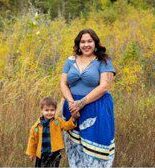
Shaila Moodie’s reflective essay directly addresses the impact of colonialism and emphasizes healing with clarity and purpose. The author shares their experience as part of a generation that lost its language and spiritual culture, highlighting the importance of reclaiming and passing on that knowledge. This illustrates that land-based education goes beyond curriculum; it is a response to historical disruption, with each student participating in an act of recovery.The insight that the Cree language is descriptive and that the land reveals these descriptions is significant. The author gained this understanding not from textbooks but through a salmon meal with Elders on the coast of British Columbia, showcasing how such knowledge is meant to be shared. This confident and meaningful essay serves as a fitting conclusion to the collection. (Dr. Ying Kong)