Editorial Note
“Like Father, Like Daughter” is a poem paired with two photographs taken thirteen years apart at Paint Lake, Manitoba. This combination transcends a single piece of writing, illustrating land-based pedagogy where knowledge is passed down through presence and patience rather than formal teaching. The lake symbolizes continuity, as a father shares not just a fishing rod but a worldview with his daughter. The poem’s repetition of “In my small Northern town” evokes rootedness, reflecting the author’s growth from a child learning patience to someone who embodies her father’s teachings. The photographs capture this journey: a little girl with her father and, years later, that same daughter with her own catch. The images echo the poem’s message with minimal words.
In my small Northern town, I was taught to roam,
Through the bush, barefoot, it has always been home.
Bare feet, and cold mornings,
World big enough to teach you patience.
In my small northern town,
I learned the language of the water,
How a lake holds memory
And a line can listen.
My father was the one who put a rod in my hand
As if he was handing me my future.
In my small Northern town, I was taught to fish,
It was my father who would say this is more than a dish
He taught me how to read the world.
Wind on the surface,
Clouds changing their minds,
The quiet before the storm,
Or in this case, the quiet that came before a bite
He never rushed me.
Just showed me, again and again,
That sometimes, good things take time.
And somewhere between cast and reel,
Between the sunlight and pine tree shadows,
I grew from his little girl
Into someone rooted.
A little rose in his care,
Blossoming into a whole garden.
So, when I fish,
When I step back into the wild
I let the water, and the trees speak.
I am not alone.
I am my father’s daughter
Carrying pieces of him
In every cast I make.
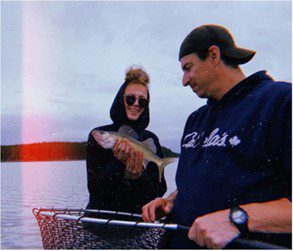
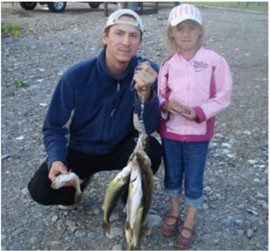
Photographs of Emily Rose Bushby and her father: Frank (Trapper) Bushby 13 years apart, same lake: Paint Lake, Manitoba