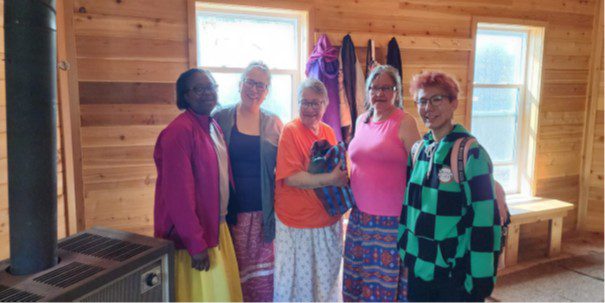
My name is Edith Obi-Rufai. I am a student at the University College of the North (UCN). On June 27, 2023, I conducted an interview with Elder Marie Ballantyne at the Manitoba Keewatinowi Okimakanak (MKO) Inc. office in Thompson. Elder Marie worked at UCN from 2016 to 2020. The purpose of this interview is to satisfy my curiosity about the Sweat Lodge and to help readers better understand the sweat lodge ceremony and its connections to truth and reconciliation.
Q: Good afternoon, Elder Marie. Could you please tell me something about yourself and your role as an Elder on the UCN campus?
A: My name is Marie Ballantyne. I am a grandmother. I have six children, but lost one. I have 21 great-grandchildren, who are from my daughters, sons, and even grandchildren. My great-grandchildren are not the only beloved ones in my life; they are also the beloved ones of my children and grandchildren. My role at UCN was to provide UCN with cultural consultations during academic learning years.
Q: What about your education?
A: My education? I never went to a residential school, and I was always a day school learner. It was after I raised my children that I went back to education. I am a Certified Therapist. I raised five children on my own, and I had six children and lost one, but over the years, I have overcome some of the hurdles of being a single parent until I met my late husband, whom I lost in 2015. I looked after him for two years before he died, and he died of cancer. So, my education, of course, was picked up again, and I picked up where I left off. In my community, it was the responsibility of the older one in the family to look after the siblings when we lost our mom; Even though I was not the firstborn in my family, it didn’t happen like that in my home. I became the person who looked after my brothers and sisters when we lost our mom, even though I was not the firstborn in my family, so my education had to be put on the shelf for a little bit, unfortunately. Now I am living here in Thompson, further than I expected. I was supposed to finish my education in Montreal, Quebec. That seems to be a faraway place for me, so I’m glad that whatever has happened to me. We always say personal prayers to ourselves, so now that I have had the opportunity, I challenged the grade 12 standard, and I got my grade 12.
Q: On the 18th of May 2023, I attended the sweat lodge ceremony. As a Native Nigerian, I felt it was foreign to me. I would like to know the importance of the sweat lodge ceremony in Aboriginal culture and tradition. What is the purpose of the sweat lodge ceremony in terms of culture and tradition?
A: Okay, all right. The sweat lodge ceremony is about purification and spirituality. Maybe looking at your health, you are not feeling well because of whatever you might have been eating or the environment you might be living in. It could be water, the food chain, or anything like that. You go into the sweat; you ask for directions: you ask for prayers. Prayers are said to the people on earth to live. Particularly, the second round in the sweat lodge is for healing, so there is a song we sang for healing and prayers we say for healing. And other people go into sweat lodges for primary purposes, such as to look after their health mentally, physically, and spiritually.
Q: I realized that the sweat lodge ceremony has four rounds. Could you please explain how those rounds work and what each round represents?
A: The first round is the opening; it is the welcoming. Everybody is welcomed into the sweat lodge, and the person conducting the sweat lodge explains the whole process. Why are we there? Whatever they come for, it is for personal healing. You are there to say something that you want to express, many times. Inside the sweat lodge, confidentiality is what controls the ceremony. You can’t talk about what you said inside the sweat lodge because it is against the spiritual purpose of the ceremony. So, that is the first round. Once we offer tobacco around the grandfather’s rocks, they are no longer rocks because they’ve been there for thousands of years listening to us, and we understand that because it is explained to us in the ceremony.
During the first round, we splash the medicine, which is water, and you start praying. Our medicine water is women’s medicine. We know that it is splashed four times. People understand why they are there, and they start discussing what they want in terms of healing. Someone might come there for a reason, and they may have a hard time looking after themselves if they are breastfeeding and their milk supply is not as it should be, perhaps because they don’t know what proper nutrition is.
They need to eat to make the baby healthy. So, now that we know what is wrong, we will sit the person down and talk to her. So, all these things are essential. For every round that we have, we have medicine that is put into the grandfather’s rocks four times. The four splashes are not just like 1, 2, 3, 4; every time you splash, you say a prayer for your personal well-being and your overall health. So, that is the purpose of the first round.
So, the second round is the healing round. We talked about what we need to look after mentally, physically, and spiritually; those three components of human beings, and that is what we say of the teaching of the sweet grass, which is done in three parts; we pray, and the prayers teach you as well, and this makes you remember the purpose of why you are there, what you are responsible for, to look after your well-being.
The best way you know is how to look after your spirituality; the best way to know your physical well-being is that you know if you never walk then, you will be wondering why you are not feeling well, then you must walk, walk, walk till you sweat profusely, and we know that. So, a lot of people continue coming to the sweat lodge on their own, we pray for all well-being all the time, some people are often afraid to be in a dark place, so they ask for protection for prayers because they may have what is holding them back from what they wanted to learn.
The third round talked about the seven natural laws. Do you know why? As you are curious to see if I am respectful and humble, or if I humble myself in front of my peers or those I come into contact with. Am I prepared to sit down and talk with that person? As I learn to be humble, do I have the courage? Because you need courage to be where you are when you ask questions. You will want to secure your academic career; you have to always remember that.
The other one is learning how to share. In our culture, we share everything that we need for our family to survive. If we know they might move into a house without furniture, we will make a donation. As you know, that is how we survived all those years looking after each other, and of course, we practice honesty. Honesty is something that is highly regarded above all the other seven natural laws because it teaches you to be a better person; it teaches you to recognize that you have a connection with the Creator, so you understand Him. In other religions, they believe in the teachings of Buddha.
You explore other cultures to really appreciate who you are, and later, the conductor of the ceremony will talk about how to appreciate who you are. You must appreciate all other cultures in the sweat lodge, you know that sanctuary is someone who talks about teaching human beings.
The fourth round of the sweat lodge is the closing of the ceremony. It talks about our lives, our own lives, our demise, the time that has arisen, what we have done in this world, and what we have accomplished. A new beginning, another opportunity —that is what it’s about. The sweat lodge ceremony teaches us to be humble human beings.
Q: So, I noticed that there are lots of prayers and songs during the sweat lodge. What are the songs and prayers for?
A: The prayers could be to pray for your family, prayers for healing, prayers for celebrations; maybe someone in your family is getting prepared to get married. Our culture teaches us that a long time ago, babies were born in winter; they were all born in the springtime because it was a time for a woman to gather herself straight because her husband had to go hunting, and he had to look after the home and the newborn. But if she has a baby in winter, it will be ten times harder for her.
So, they look at that sometimes, and ask when they say we are going to have a parenting course?” “Okay,” I say, and then I sit and listen to their delivery date, and they are totally laughing. You know it’s our culture to have our way of doing things. Nowadays, a lot of women have their babies in the hospital, but we still honour them after the birth of the placenta. We remember that the baby was there for 9 months, so there is a ceremony for that. When the little one finishes crawling around and starts walking, we have a walking-out ceremony for them. So, celebrations are something we value a lot.
Q: How can a sweat lodge ceremony contribute to the truth and reconciliation process?
A: When you are going to the sweat lodge, you are going to achieve victory; you are going back to where you experience safety; you are going to a place where you know what you are going to share is going to stay for being there, and reconciliation itself has a lot of it attached to the residential school system. A lot of people have grown up inside those institutions, never knowing where they belong. When they come back to their own territory, they do not even speak our language. It is hard for them to make the adjustment, and to whom do we apologize? The government has a big impact, and the churches also have an impact. They wanted us to be like them, and we couldn’t. We just said, “Well, I am me; you cannot change my ways of thinking”. “But the thing is that I must be able to talk about it honestly, even in the day school system, and I shared that with you when you arrived.
When we woke up in the morning, we did not have breakfast right away. We went to church. We were not allowed to drink water. We just put on our clothes and went to church, no water, nothing. We were made to sit there in church for one hour, and we went home. When we were about to have our breakfast, it was water, but prior to that, we must receive holy communion before anything, and they call it the bread of life. We knew we must have that, so we went home. After breakfast, we then got ready for school. We were never allowed to wear our regular clothes when we got to school.
We had to change into our uniforms, our gloves, and our dresses. As you know, white socks, black shoes. Your nails had to be cut and your hair had to be in place, and you did not speak your language when you stepped into the classroom. This was a day school, and we started our class by saying the Lord’s Prayer. We had recess after recess, and we said again the Lord’s Prayer. Then at lunchtime, we went home for lunch. We got back to school, and we had to pray again. Then, when we were in the classroom, we went out for recess for fifteen minutes. Back in class, we had to pray again. After school, we must pray for the final day in the classroom, and we are home.
At supper time, before supper, the bell rang at Mission. We all had to go to the mission, and we all had to go to church for benediction. The last prayer of the day was at night before we went to bed. We said our prayers, whether we wanted to or not. We didn’t have any choice. Everybody, twenty-five students in the classroom, would have to do it. Another time, you asked me how I reconcile with that. With a lot of anger, a lot of disappointment, and a lot of what did I do wrong, you know. Why do I have to live through that? I’m always going to be like that. Now reconciliation means, for me, coming to terms with what happened so that this will never happen to us, and that this will never happen again. This is reconciliation for me.
Q: What is the etiquette for attending a sweat lodge ceremony?
A: When attending a sweat lodge ceremony, you know you are going to a sacred place. Like I said before, it’s a place of comfort, a place of safety, a place of security. Everybody at the sweat lodge has a common goal, knowing that we are there for a purpose and reason. We are looking for a better upcoming life, and it teaches you how to live a good life instead of hanging on to something that happened ten or twenty years ago. You know that’s where you put everything aside, and you don’t want any more than that. You know this is your new life, a better life.
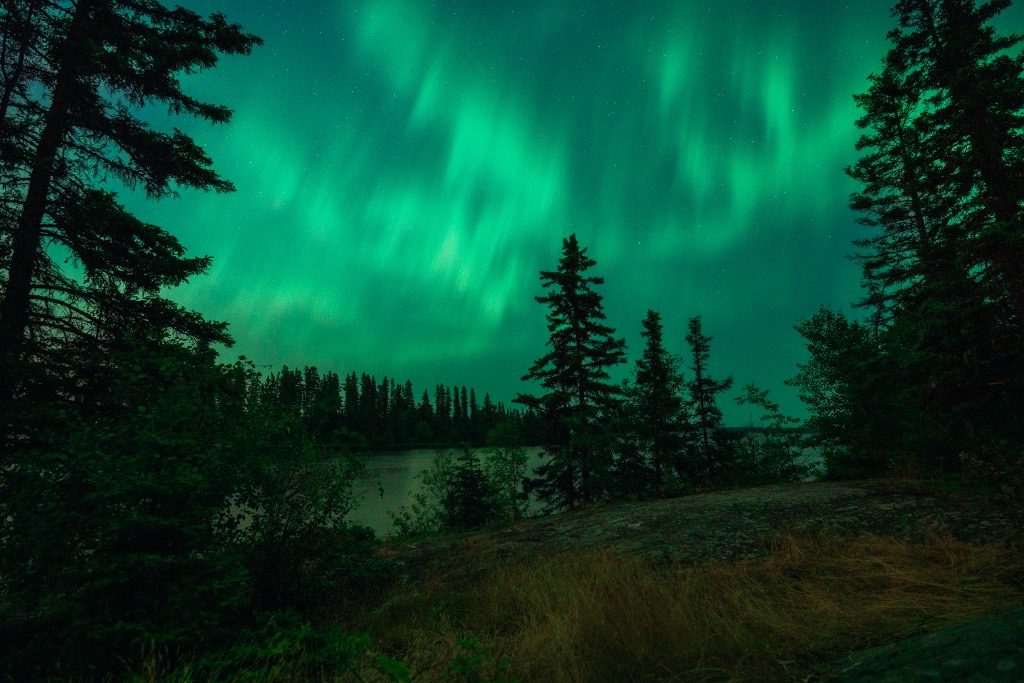
Edith: This concludes my interview with you. Elder Marie Ballantyne today. I appreciate the opportunity to interview you. I visited Mile 20 twice and saw the traditional aspects and how Aboriginal people keep their traditions alive. I was welcomed. It was lovely to see your sister, cousins, and nieces. I thank you for the privilege you have given me today again, and I hope the little gift I am presenting to you (the tobacco, sweet grass, and eagle feather in this gift bag with a Northern Lights design) is appreciated. Also. when I am done, I will send you a copy for approval.