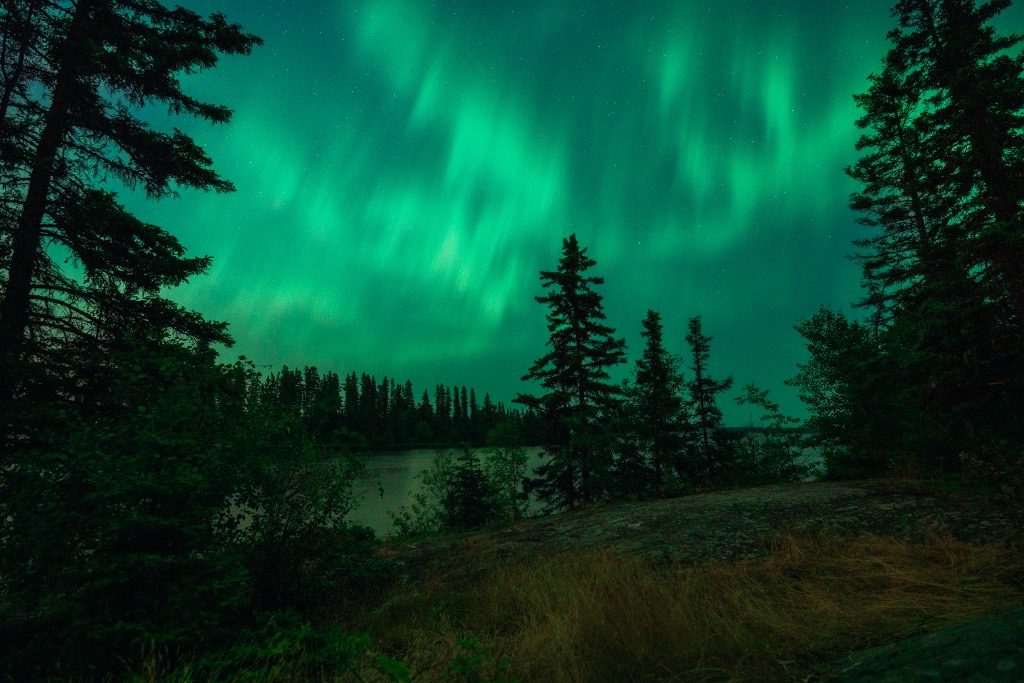
Winter winds howled across the vast, snow-covered fields outside Shanelle’s small home on the reserve. The wooden house stood resolute against the cold, much like its inhabitants—Shanelle and her parents. At seventeen, Shanelle found herself caught between two worlds: her ancestors’ traditions, which she barely understood but strived to learn about, and a modern life that felt too fast to follow yet seemed inescapable.
Inside, the scent of her mother Ann’s cooking mingled with the soft, earthy aroma of sage. Ann was moving about the kitchen with deliberate but weary movements, preparing dinner. Across the room, her father, Pete, sharpened an old hunting knife, his movements steady but his gaze distant.
Shanelle sat near the window, her breath fogging the frosty glass as she gazed out at the horizon. She didn’t know what she was searching for; she only felt that something essential was missing—a piece of herself she couldn’t quite define.
“Shanelle,” Ann called, her voice soft yet firm, “come smudge and pray with me.”
Shanelle hesitated. She had watched her mother perform the smudging ceremony countless times, her prayers rising like smoke to the Creator. However, Shanelle always felt like an outsider to the ritual. “Not today, Mama,” she replied, her voice barely above a whisper. Each time her mother had asked her, she struggled with her feelings. She knew nothing about smudging—what it meant, how to perform it, or why her mother insisted she join in. She wondered what smudging had to do with her culture.
Shanelle’s father, Pete, looked her up and down, his brows furrowed. “You spend too much time staring out that window,” he muttered roughly. “What are you even looking for out there?”
“I don’t know,” Shanelle replied, her voice tinged with frustration.
In truth, she wasn’t waiting for anything—she was searching. She was searching for answers, meaning, and a way to piece together the fractured parts of her family’s story. She understood that generational trauma shaped her, her parents, and her grandparents. She saw it in her father’s quiet, distant stares and in the way her mother carried her exhaustion like an invisible weight.
Unlike the parents of her peers, who openly shared their childhood memories, Shanelle’s parents rarely spoke about the past. Their silence made them seem different. Other families appeared open, laughing, and at ease, while her own home felt filled with unspoken words. She often wondered how her parents navigated their days while carrying such heavy burdens. Her father suppressed his emotions, with his anger surfacing in frustrated outbursts, while her mother was soft-spoken, always careful with her words and carrying her pain in silence. Understanding her family was one challenge; healing from it was another.
One evening, during a quiet dinner of moose meat and potatoes, the three of them sat around the table. The atmosphere was still, broken only by the sound of forks clinking against plates. Shanelle cleared her throat and cautiously broached a topic that had remained unspoken for years.
“Mama, Papa,” she began, “what happened to Koko and Mishoomis in the residential schools?”
The question lingered in the air, heavy and impossible to ignore. Ann hesitated, her hand trembling as she set down her fork. Pete’s jaw tightened, and his fists clenched around his utensils.
“Why are you asking about this now?” Pete’s voice was sharp and defensive.
“I just… I feel like I don’t really know who we are,” Shanelle replied softly. “What happened to you since you’ve never been there? How could residential schools affect you?”
Ann reached out and placed her hand over Shanelle’s. She noticed that her daughter’s hands were warm, despite the chill in the room. “Your grandparents endured things that no one should ever have to experience. Those experiences affected them, and in turn, they have affected us. It’s good that you want to understand. We’ve hidden from this for too long.”
Abruptly, Pete pushed his chair back, the sound of it scraping against the floor breaking the silence. Without saying a word, he left the table, his heavy boots thudding down the hall.
Shanelle flinched, her heart pounding. Her father’s sudden departure left a lump in her throat. Was this what her mother meant when she said he carried pain? Did he leave because he didn’t want to confront it? She swallowed hard, staring at the untouched food on her plate, unsure of what to say or do.
Ann sighed, “He’s carried their pain all his life, Shanelle. Be patient with your father; healing takes time.”
The following week, Ann handed Shanelle a small leather pouch filled with sage, sweetgrass, cedar, and tobacco. As Shanelle opened it, the faint, earthy scent filled the air. In that moment, she felt a shift within herself. She realized she wasn’t just holding plants; she was holding knowledge, tradition, and a sense of connection.
“These are the medicines,” Ann explained. “They are part of the Seven Teachings that your Koko once shared with me.”
She guided Shanelle’s hand over an eagle carving on the pouch. “Each teaching is linked to an animal,” she said. “The eagle represents love because it flies the highest and sees the furthest.”
Ann then opened a worn book and showed Shanelle illustrations of the Seven Teachings, tracing her finger over the animals as she spoke. “Your Koko used to tell me these stories when I was a child,” she whispered. “I should have shared them with you sooner.”
Later, Ann took Shanelle to the community centre, sensing her daughter’s growing curiosity. Shanelle wanted to learn more, and Ann saw this as an opportunity to provide her with what she had been missing for a long time.
At the centre, Alexis, a respected elder, was teaching a group of young people about cultural traditions. The community centre served as a space for reconnection. It was warm, filled with the soft hum of voices eager to reclaim their heritage. As Alexis shared her teachings, Shanelle listened intently, absorbing every word. That night, when she placed the pouch on her bedside table, she realized she didn’t feel as lost as she had before.
One chilly evening, Shanelle entered the garage, where Pete was bent over the broken engine of an old snowmobile. The smell of motor oil and the sharp scent of whiskey lingered in the air.
“Papa,” she began, hesitating, “why are you so angry all the time?”
Pete paused, his grip tightening on a wrench. “I don’t know how to stop.”
“That’s not what I asked, Dad.” Shanelle’s voice remained steady. “I want to know why. I’m not just asking why you’re angry; I’m asking about the reasons behind it.”
He set the wrench down and finally turned to her. “They never talked about it, but their silence and actions spoke louder than words. I grew up feeling their pain and fear. It’s like a shadow that never leaves.”
Shanelle knelt beside him. “We can’t change what happened to them, Dad. But maybe we can learn to heal together.”
For the first time, Pete allowed his tears to fall. As Shanelle wrapped her arms around him, something shifted between them. The distance between father and daughter began to close. Pete didn’t have all the answers, but at least now, he wasn’t facing his pain alone.
Weeks later, Ann invited Shanelle and Pete to a community healing ceremony. Pete hesitated to attend but ultimately agreed. The gathering took place near the river, where elders spoke about the scars left by the residential school system. One by one, people stepped forward to share their stories. The fire crackled as Pete finally rose, his hands shaking slightly.
“My parents never spoke about what happened to them in the residential schools,” he admitted. “But I could see it in the way they held themselves, in the silence that existed between us, and how it shaped our family relationships. I carried that silence, too. Now I realize that I have passed it on to my own family.”
The circle remained quiet, listening—not judging or pushing—just holding space for him. When Pete sat back down, Shanelle reached for his hand, and he squeezed back.
From that day forward, something shifted. Mornings felt lighter. Pete and Shanelle began to communicate more, even if it was just about small things at first. He taught her how to hunt, just as his father had once done for him. Their garage, which had been filled with silence and distance, transformed into a place of laughter and learning together.
One evening, Shanelle stood by the Red River, holding an eagle feather in her hand. The river had always been there, flowing and constant, much like the resilience of her ancestors. It was the same river that had carried her people’s pain, but also their prayers, hopes, and strength. She whispered a prayer, her words carried by the gentle breeze.
The wind seemed to respond, wrapping around her like an embrace. In that moment, she felt the presence of her ancestors, her parents, and her true self. For the first time in her life, Shanelle knew exactly who she was.
Who am I, and what was our history? — Author’s story about her identity in bilingual:
This submission contains both English and Anishinaabemowin text. A fluent speaker has not reviewed the Anishinaabemowin portions due to time and resource constraints. The content appears as submitted by the Indigenous student author. We welcome feedback from Anishinaabemowin speakers regarding the accuracy of the Indigenous language content.
I was born into a story that began long before me, shaped by the footsteps of my grandparents, who walked through the doors of residential schools and carried that weight home. That burden settled onto my parents, shaping them in ways they never spoke about. My father carried his trauma in his anger, lashing out at the world, at the people around him, and at himself. My mother bore her pain in silence, holding everything inside as if voicing it would make it real all over again. And I? I was left trying to understand the history I inherited and the home around me, grappling with why my reservation was a place of hurt and lost people, and why we were so often misunderstood.
Growing up on the reservation, I saw how history lived in us. I observed it in my father’s past, which made him a man of fire and shadows, and in my mother’s quiet suffering, which became something I inherited without even realizing it. I noticed it in the missing social media posts of women I knew and, in the way, violence never felt distant—it was here, in our homes, our streets, and in the stories whispered between mothers and daughters. The world had always been dangerous for us, and I grew up knowing that, but I never understood why it had to be that way.
I struggle with belief—not just in something greater, but in myself. I don’t know my culture as well as I feel I should. I don’t know the language, the ceremonies, or the ways of being that my ancestors carried with them before everything was taken. This lack of knowledge makes me feel ashamed. How can I call myself Indigenous when I don’t fully understand what that means? How do I reclaim something that feels both mine and out of reach at the same time? But I am still here. We are still here. And I am learning.
I am learning that resilience is not just about survival; it is about questioning, searching, and refusing to let the past define the future. It is about looking at the pieces of my culture that I have yet to understand and realizing they are still mine to hold and learn. It is about recognizing that my parents’ pain was not their fault, and neither is mine. It is knowing that even though I do not have all the answers, I am allowed to find them in my own way and in my own time. To those who are still searching and struggling to believe: You are not alone. Our stories are not over. And neither are we.
Niin gii-baniigoon e-mii gii-mikwendan wii-bzindan, ndoo-bizhigwaashijig. Ndoshimisag gii-anishinaabewag gii-gikendamaagoziwag gii-giizhiitaa gii-kendaanaawaa ndoo-anishinaabe-gikendaasowin. Mii sa dash gii-pi-wiindamaagewag omaa gii-paa-giiwenh gii-dagoshinowaad.
Ndoo-dedebaagizid gii-bimaadiziwan miinwaa gii-niizhooshinaabewag. Ndooshibaan gii-mikwendaan gikinoo’amaadiwin, gii-giizhiitaa ji-nisidotamowaad. Ndooshibaan kwe gii-mikwendaan bezhig miinwaa mii gii-bi-dagoshinowag, mii gii-aabajitoowaad gii-mikwendang gii-anishinaabemowin.
Aapiji gii-noondamaan gii-pi-dagoshinoowag. Mii sa dash gii-anishinaabe-gikendaasowin gii-pi-dagoshinoowag gii-mikwendan gii-bi-nisidotamowin. Ndoo-dedebaagizid gii-nisidotamowaad gii-nisidotamowaad. Mii sa dash gii-bi-anishinaabe gii-bi-nisidotamowaad gii-bi-aabajitoowaad gii-mikwendang gii-anishinaabemowin.
Niin sa gii-pii-anishinaabemowin. Gii-pii-anishinaabemowin gii-bi-dagoshinoowag gii-bi-dagoshinoowag. Mii sa dash gii-bi-dagoshinoowag gii-bi-nisidotamowaad gii-anishinaabe-gikendaasowin. Gii-bi-dagoshinoowag gii-bi-aabajitoowaad gii-bi-anishinaabe-gikendaasowin. Gii-bi-anishinaabemowin gii-bi-nisidotamowaad gii-bi-dagoshinoowag.
Aanind dash gii-bizindamowaad: Gii-bi-anishinaabe-gikendaasowin gii-bi-dagoshinoowag gii-bi-dagoshinoowag gii-bi-nisidotamowaad. Mii sa dash gii-bi-dagoshinoowag gii-bi-nisidotamowaad gii-bi-anishinaabe-gikendaasowin.