
Editorial Note
This PhotoVoice essay is included in the special issue on land-based learning and is based on work the author originally developed in ANS 2100: Research Methods in the Aboriginal and Northern Studies program at UCN. It serves as an example of how Indigenous research methodology can be not only taught but also actively experienced-where the canoe, family, and river become integral tools for inquiry.
Introduction
For this project, we are examining the modern impact of Manitoba Hydro on northern Manitoba waterways. More specifically, the Keeyask Hydro Dam is located on the Nelson River approximately seventy-five kilometres downstream from Split Lake. Birthday Rapids was the area of interest where the floodplain from Keeyask would eventually meet once full operations started. This journey addresses how Manitoba Hydro has impacted the social, economic, and political realities in the lives oflndigenous people, starting from my community of Pimicikamak to Gillam.
Manitoba Hydro started construction on Keeyask in 2012, and it was in commercial operation by February 18, 2021 (Keeyask Generation Project, 2019). The news of this was devastating to numerous Indigenous communities, even though it was described as a joint venture with Tataskweyak Cree Nation, War Lake First Nation, York Factory First Nation, and Fox Lake First Nation (Mackintosh, 2004; Owen, 2014). It represented another loss of traditional territory and the permanent alteration of waterways that hold ecological and spiritual meaning for Indigenous peoples.
Research Approach: PhotoVoice and Indigenous Methodology
This project draws on Indigenous qualitative research approaches combined with PhotoVoice methodology. PhotoVoice is a participatory research method that uses photographs and storytelling to document lived experiences and community perspectives. Through photographs, personal narratives, and reflections, PhotoVoice allows participants to capture moments that illustrate social realities and environmental change.
In Indigenous research contexts, storytelling, land relationships, and lived experience are central forms of knowledge production (Tuhiwai Smith, 1999). Using PhotoVoice allows the researcher to document not only what is seen but also the emotional and cultural meanings attached to place. The photographs from the journey to Birthday Rapids serve as visual documentation of landscapes that are changing due to hydroelectric development. They also represent acts of witnessing and remembering. Indigenous research methodologies emphasize relationships with land, community memory, and responsibility to future generations, making PhotoVoice a meaningful way to document environmental change.
The Journey to Birthday Rapids
One area in particular was special: Birthday Rapids. This place became the focus of our story and the reason we travelled by canoe along the Nelson River to witness the landscape before it would be permanently altered by hydroelectric development. Birthday Rapids is a short but powerful cascade of water located northeast of Split Lake. For generations, Indigenous travellers knew it as an important landmark along the river system.
In January 2018, my brother Nathan Beardy proposed paddling the Nelson River to see Birthday Rapids before the Keeyask project fully flooded the surrounding areas. At the time, he was working as an Aboriginal Liaison for Manitoba Hydro and was aware of the coming changes to the waterways south of the dam. He felt it was important that we witness the original riverbanks our ancestors had travelled along only a few generations earlier.
Our journey began from the banks of our home in Pimicikamak Cree Nation and continued north toward Gillam, Manitoba. We carefully planned the route because we would be travelling not by motorboat but by warrior canoe. The canoe was large enough to hold many people, but in the end, it was mainly our family who took part in the journey. My parents, Ronnie and Elaine Beardy, joined us, along with my daughter Maya, my nephew Bryce, my brother Nathan, his daughter Kamara, and his wife. Even our small dog Romeo travelled with us.
Travelling together as a family echoed the ways our ancestors once travelled these waterways while hunting, fishing, and maintaining traplines. The river holds generations of stories and memories. For many Elders, the water once ran clear, and the riverbanks were rich with wildlife and plant life. Today, the river has changed. The water is often murky and fluctuates dramatically due to hydroelectric regulation.
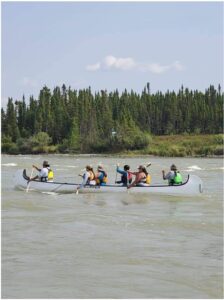
Family members paddling the Nelson River toward Birthday Rapids, January 2018. Photograph by the contributor.
Reflections: What the River Carries
Several themes emerged from reflecting on this journey and the broader history of hydroelectric development in northern Manitoba. The first is environmental transformation. Hydroelectric projects such as Jenpeg and Keeyask have significantly altered the natural flow of the Nelson River. These alterations affect fish habitats, shoreline ecosystems, and traditional harvesting areas (Craft & Blakley, 2022; Luby, 2022). Fluctuating water levels have also caused dangerous conditions for trappers and travellers who rely on the river during winter.
A second theme is the emotional and cultural impact on communities. When we stopped in places such as York Landing and Split Lake, we encountered people with mixed feelings about the Keeyask project. Some recognized the economic opportunities created by employment with Manitoba Hydro, while others felt anger and frustration about the lack of meaningful consultation. Community members described how agreements were sometimes negotiated at leadership levels without broad community support.
These tensions highlight a broader colonial history of resource development in northern Manitoba. For decades, Indigenous communities have experienced hydroelectric development that flooded traplines, changed migration patterns for animals, and altered sacred places (Cox, 2018). While agreements such as the Northern Flood Agreement attempted to address some of these impacts, many communities continue to struggle with the long-term environmental consequences.
Another theme emerging from this journey is witnessing. By travelling to Birthday Rapids before the flooding, our family participated in an act of witnessing. We saw the river as it existed before further industrial alteration. This act of witnessing is important because it allows stories to be carried forward. Future generations may only know these places through stories, photographs, and community memory.
PhotoVoice helps transform these experiences into a form of documentation. Photographs taken during the journey capture the landscape, the rapids, and the people who travelled together. These images help communicate the emotional and cultural weight of the journey. They remind viewers that hydroelectric development is not simply an engineering project but a transformation of living landscapes.
At the same time, this reflection must acknowledge the complex reality of economic development in northern communities. Manitoba Hydro has created employment opportunities, training programs, and compensation agreements for some communities. For many families, these jobs provide stability and income in regions where employment options are limited. This creates a difficult balance between economic survival and environmental protection.
Ultimately, the journey to Birthday Rapids reflects the broader struggle Indigenous communities face when resource development occurs on their lands. Communities must navigate between protecting cultural landscapes and participating in economic systems that shape modern life. Documenting these stories through Indigenous research approaches ensures that these experiences are not forgotten.
Conclusion
Through PhotoVoice and storytelling, this research documents more than a physical journey. It captures a moment in time when a river, a landscape, and a community stood at the edge of transformation. Recording these stories ensures that even as the water rises, the memory of Birthday Rapids and the people who travelled there will remain.
After the journey to Birthday, it was a bittersweet experience to admire the beauty of the land, the history, and the people. To have witnessed the devastation of the people and their spiritual beings. Modern progress continues to increase its need for power, and Northern Manitoba is the go-to place for “clean energy,” about which there is little noise on how much it impacts the environment or violates treaties with Indigenous communities. Did we ever really have a choice? All we can do is grasp onto what was left and mourn what we continue to lose – a majestic cascade of water- and be the voice to tell the story of a place that is nothing more than an echo now.
References
Cox, S. (2018). Breaching the peace: The Site C dam and the valleys stand against big hydro.
Craft, A, & Blakley, J. (2022). In our backyard: Keeyask and the legacy of hydroelectric development.
Keeyask Generation Project. (2019). Year in review: April 2018 -March 2019.
Luby, B. (2022). By water we inhabit this place: Respecting sacred relationships. Canada s History.
Mackintosh, G. (2004). The Environmental Act: Keeyask Hydropower Limited Partnership Licence 3107.
Owen, B. (2014). Hydro gets green light for Keeyask dam. Winnipeg Free Press.
Smith, L. T. (1999). Decolonizing methodologies: Research and Indigenous peoples.

About the Author
Editor's Remarks
Fawn Morales’ PhotoVoice essay documents a 2018 canoe journey along the Nelson River to Birthday Rapids, a site of ecological and cultural significance to Pimicikamak Cree Nation that was subsequently altered by the Keeyask Hydroelectric Project. Using PhotoVoice – narrative to document lived experience – the author weaves family memory, community testimony, and critical analysis into a unified act of witnessing.
Using a PhotoVoice-inspired methodology, the paper documents a canoe journey along the Nelson River to Birthday Rapids-an ecologically and culturally significant site later affected by the Keeyask Hydroelectric Project. What makes this work particularly compelling is its grounding in lived experience. The student situates family memory, community relationships, and direct engagement with the land within broader discussions of colonial resource extraction and environmental transformation.
The strength of this paper lies in its ability to bridge storytelling and academic inquiry. Rather than separating personal narrative from research, the author demonstrates how Indigenous methodologies-rooted in relationality, witnessing, and responsibility to land-can offer powerful insights into contemporary issues. The act of travelling to Birthday Rapids becomes not only a journey across space but also a form of documentation, remembrance, and resistance. (Dr. Asfia Kamal)